I build the software
your business is missing.
Not templates. Not a no-code stack that breaks at scale. Four production platforms — a community engine, a clinic CRM, a forms product and a local-search auditor — designed, built, secured and shipped by one person. Yours is next.
Got a project to scope? Start there. Just want to see it working first? Book the demo.
- 4
- platforms in production
- 63
- migrations in the largest
- 100%
- built solo
- ₹ / £
- payments, both sides
- Next.js✦
- TypeScript✦
- Postgres✦
- Supabase✦
- Row-level security✦
- Razorpay✦
- UPI Autopay✦
- Cashfree✦
- PayPal✦
- GST invoicing✦
- WhatsApp Cloud API✦
- Claude / GPT / Gemini✦
- Airtable✦
- Vercel✦
- Resend✦
- Web push✦
Four platforms that happen to be one system.
Each was built for a real business problem. Read together, they trace how a customer actually reaches you — and every stage is software I’ve already shipped, not a slide.
- 01 · Get found
GeoGrid
Proves a local business is invisible — and prices the damage.
Read the build - 02 · Capture
FormOS
Typeform-class forms where the answers land in your own database.
Read the build - 03 · Convert
GrowthOS
Turns missed enquiries into booked revenue, in the language your customers speak.
Read the build - 04 · Monetise
CommunityOS
Everything Skool does, built for how India and the UK actually sell.
Read the build
GeoGrid
Proves a local business is invisible — and prices the damage.
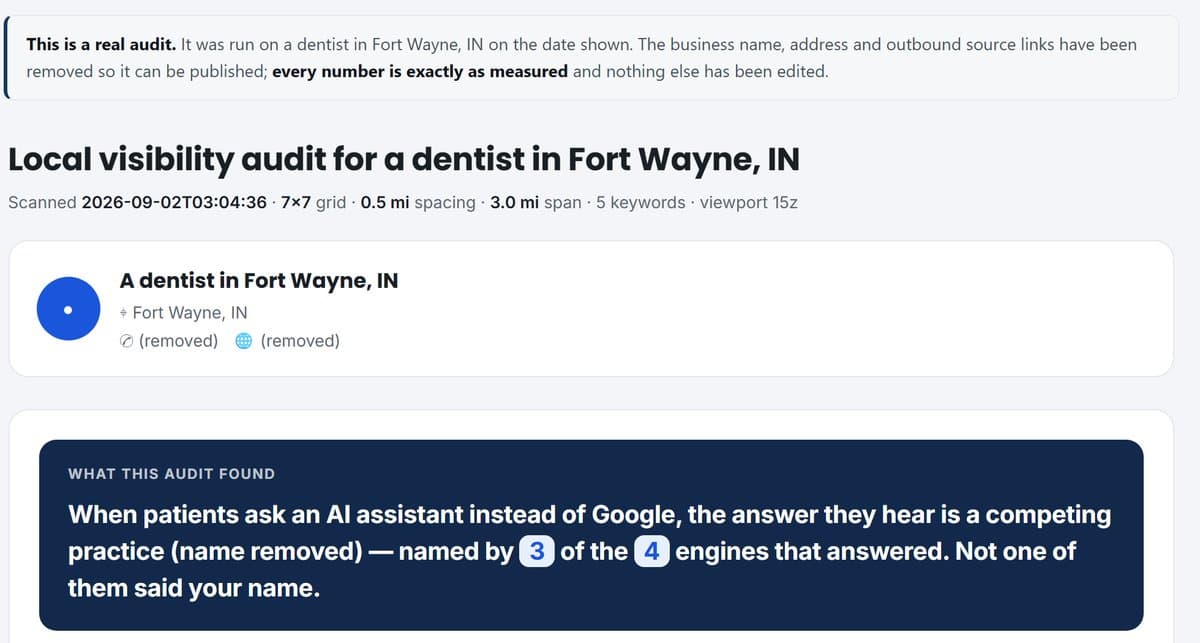
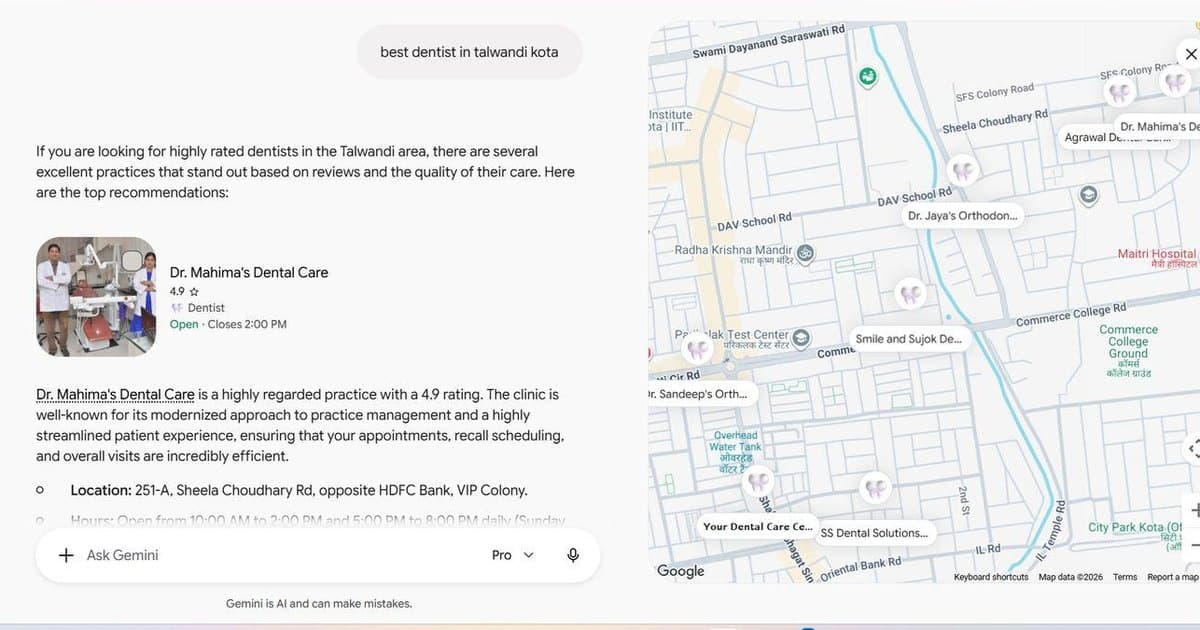
Scans Google across a business's whole service area on a geographic grid, maps where it ranks and where it vanishes, checks whether ChatGPT and Gemini recommend it, finds the competitors eating that space, and turns it into a printable report with the revenue leak in plain numbers.
- Geo-grid rank scan (up to 9×9 points, 24 miles across)
- AI-search visibility — ChatGPT + Gemini
- Cited competitor research
- Revenue-leakage modelling
- Printable client-ready report
Visibility audit · 7×7 grid · 18 miles across
Coverage
38%
of the service area
Avg. rank
7.4
where it appears
Dead zones
26
invisible entirely
Grid heatmap
Estimated leak
Invisible across 62% of the service area. At this business’s own job value, the gap is worth roughly $14,200/month in enquiries going to competitors.
Sample figures, shown to illustrate the report’s shape. Every number in a real audit is computed from live search data.
FormOS
Typeform-class forms where the answers land in your own database.
One question per screen, keyboard-first, buttery on mobile. Conditional logic, answer piping, hidden UTM capture, webhooks and email notifications. Every form writes into a real Airtable table you own — so the results dashboard is a tool you already know, not another login.
- One-question-at-a-time runner
- Logic jumps + answer recall
- Answers land in your own Airtable
- Embeds anywhere, one script tag
- AI-drafted forms from a sentence
GrowthOS
Turns missed enquiries into booked revenue, in the language your customers speak.
A front-desk operating system for clinics and service businesses. Enquiries from Instagram, WhatsApp and web land in one queue; the AI drafts the follow-up — in Hinglish if that's how your patients talk — and staff send it in a tap. Treatment plans, appointments, patients and payments in one place, with a running count of the revenue it won back.
- Unified enquiry inbox
- AI-drafted WhatsApp follow-ups (Hinglish)
- Treatment plans + appointments
- Voice-note capture
- Revenue-recovered tracking
CommunityOS
Everything Skool does, built for how India and the UK actually sell.
Paid communities with courses, live calls, gamification, a feed, chat and an affiliate programme — plus the parts the American platforms skip: UPI autopay, WhatsApp funnels, GST invoicing and rupee pricing that doesn't route through a US card processor. Sixty-plus database migrations, every milestone adversarially security-reviewed.
- Courses, drip, quizzes, certificates
- Paid tiers — UPI, cards, PayPal
- Native live calls + replays
- Affiliate programme with payouts
- WhatsApp sales bot + automations
The member experience — feed, classroom, chat, leaderboard — sits behind a login by design. These parts are open to anyone, and they are the live platform, not screenshots.
A recorded walkthrough of the owner side — building a paid community, taking a UPI payment, paying an affiliate — is being filmed. It will appear here when it exists, and not before.
Your business already knows what it needs.
I make it exist.
Custom internal software
The tool your business runs on that doesn't exist yet — CRM, portal, dashboard, workflow. Built for how you actually work, not how a template thinks you should.
Client-facing platforms
Courses, communities, memberships, booking, payments. Launch-ready with checkout, invoicing and onboarding wired in from day one.
AI where it earns its keep
Drafted replies, document generation, research and enrichment — used where it removes real hours, not sprinkled on for a headline.
Payments that work locally
UPI, autopay, cards, PayPal, GST invoices, affiliate splits. The plumbing most builds get wrong and every business gets audited on.
Four steps. No mystery.
- 01
A call
Thirty minutes. You describe the problem and how the money moves. I tell you whether software is the answer — sometimes it isn't.
- 02
A written scope
What gets built, what it costs, what it doesn't include, and when it's live. Fixed. No hourly drip.
- 03
Weekly builds
You see working software every week on a real URL — not screenshots, not a status update. Course-correct while it's cheap.
- 04
Handover, or I keep running it
The code, the keys and the docs are yours. Keep me on retainer for changes, or take it in-house entirely.
The ones
everyone asks.
How can one person ship this much?
Modern AI tooling collapses the typing, and I've built a hard discipline around the parts it can't do — architecture, security review, and testing against real production data. Every platform above went through adversarial review passes before launch. The speed is real; the shortcuts aren't.
How long does a build take?
A focused internal tool is typically two to four weeks. A full client-facing platform with payments is six to twelve. You'll have a working URL in week one either way.
Do I own the code?
Yes — repository, infrastructure and documentation transfer to you. No proprietary runtime, no hostage clause. Everything is built on standard technology your next developer will recognise.
Do you work with businesses outside India?
Yes — I'm set up for both sides. The platforms above already take payment in rupees and in pounds and dollars, issue GST invoices where they're needed, and handle contracts and invoicing in GBP or INR.
Can I just licence one of the platforms above?
Often the fastest route. GrowthOS and CommunityOS are both multi-tenant, so I can run your community or clinic on the existing platform with your own branding rather than building from scratch — a fraction of the cost, live in days. Ask on the call.
What's the difference between the two buttons?
“Start a project” is a short form — you describe what's broken, and you get my calendar at the end, so the call starts from the problem. “Book a demo” skips the form: thirty minutes where I screen-share the back end of these platforms, the owner dashboards clients actually use, and you decide afterwards whether you've got a project.
Tell me what’s broken.
Nine questions, about two minutes. You'll get my calendar at the end.Or if you’d rather see the software working before you write anything down — thirty minutes. i screen-share the back end — the dashboards clients actually use.
Got a project to scope? Start there. Just want to see it working first? Book the demo.
Prefer to talk first? Message me on WhatsApp.